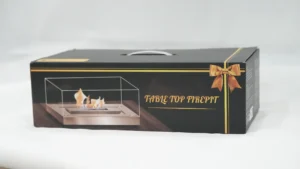
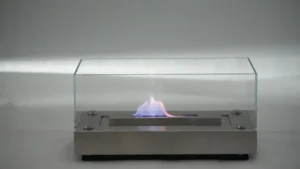
Quick Answer: EN 16647 factory production control is the part of the buyer conversation that connects a compliant test sample to repeatable bulk production. A type-test report can show how one tabletop ethanol fireplace sample performed under defined test conditions. It does not, by itself, prove that every future batch will use the same burner construction, glass screen, fuel box, markings, packing checks, instructions, and inspection discipline. For importers, distributors, and private-label brands, the useful question is not only “Do you have an EN 16647 report?” but also “How do you keep production aligned with the tested design?” Ask for controlled drawings, material specifications, incoming inspection records, burner leak or soundness checks, assembly inspection criteria, traceable batch records, packaging and manual control, and a process for handling nonconforming units before shipment.
For buyers comparing suppliers before RFQ, the EN 16647 fireplace manufacturer China sourcing checklist shows how to connect factory controls with documents, samples, packaging and shipment approval.
Many EU buyers already know to ask for EN 16647 evidence before placing an order for tabletop ethanol fireplaces. The harder part begins after the certificate or test report is shared. Purchasing teams still need to judge whether the supplier can keep the approved design stable when volume increases, when accessories change, when a private-label package is introduced, or when a second production line is used to catch a delivery date.
That is where factory production control, usually shortened to FPC, becomes commercially important. FPC is not a decorative phrase for a sales deck. It is the practical discipline behind repeatability: documented inputs, controlled production equipment, defined inspections, traceable records, and a clear response when something does not match the approved specification. For a product that uses liquid alcohol fuel and an open decorative flame, the gap between sample approval and mass production deserves more attention than a normal home decor accessory.
This guide is written for importers, distributors, retailers, sourcing teams, QA managers, compliance teams, and hospitality buyers who are evaluating manual tabletop ethanol fireplace suppliers. It does not replace the full EN 16647-1:2025 standard or legal advice. It gives you a structured way to ask better supplier questions before you turn a test report into a purchase order.
Why Factory Production Control Matters After a Type Test
Type testing answers one important question: can the submitted sample meet the relevant safety and test requirements under the laboratory’s conditions? For manual alcohol powered flueless fireplaces, EN 16647-1:2025 covers safety requirements and test methods for manually operated decorative fireplaces for domestic use. The public preview of the standard shows sections for construction and operation, marking, user’s manual, type testing, and factory production control. That structure is a reminder that compliance is not only a laboratory event. It also depends on what happens in ordinary production.
Bulk orders create new variables. Sheet thickness can change if purchasing substitutes material. Glass dimensions can vary if a subcontracted process is not controlled. A burner opening can drift if tooling wears. Packaging inserts can be redesigned by a branding team without rechecking warnings or instructions. A private-label manual can omit a safety statement during translation. None of those changes may look dramatic in a quotation, but each can weaken the link between the tested sample and the goods that arrive in a buyer’s warehouse.
When documentation is the next open item, review the dedicated EN 16647 labelling and user-manual requirements checklist before approving private-label artwork or translated manuals.
For this reason, the strongest supplier conversations combine document review with process review. The buyer asks for the EN 16647-1:2025 testing evidence, then asks how the factory controls the same features during production. The supplier should be able to explain which product version was tested, which drawings and specifications are locked, what inspections are performed, which records are kept, and how changes are approved. If those answers are vague, the buyer has found a risk before money and calendar pressure make it harder to fix.
What EN 16647-1:2025 Changed in the Conversation
The public preview of EN 16647-1:2025 states that it supersedes EN 16647:2015 and that the 2025 version revises Clause 9 on factory production control. It also identifies the new Part 1 as covering manually operated decorative fireplaces for domestic use, while automatic fireplaces are separated into another part. For buyers, that matters because a supplier’s older habit of saying “we follow EN 16647” may not be specific enough.
When you review a supplier, ask which exact standard version and product type the evidence covers. A manual tabletop ethanol fireplace should not be evaluated with language that belongs to automatic fireplaces, gelatinous fuel products, unrelated heaters, or a generic home decor category. If you are still comparing the old and new standard context, start with HND’s overview of EN 16647:2015 vs 2025 for tabletop ethanol fireplaces. Then bring the discussion back to the order in front of you: the model, fuel box, glass, packaging, manual, markings, and production route that will actually be shipped.
FPC is especially useful because it gives buyers a way to talk about repeatability without pretending to be the testing laboratory. You do not need to recite every clause of the standard during sourcing. You need to know whether the supplier has a controlled system that prevents quiet drift away from the tested design. Good factories usually welcome those questions because they separate serious buyers from price-only RFQs.
The Buyer Risk: One Good Sample, Many Uneven Batches
Tabletop ethanol fireplaces are compact products, but they combine materials, fuel handling, visible flame, user instructions, and retail presentation. In a first sample, the factory may hand-select parts and inspect everything twice. In mass production, hundreds or thousands of units move through purchasing, forming, welding, polishing, glass fitting, assembly, packing, and outgoing inspection. The buyer’s risk is not that the sample was meaningless. The risk is that the sample becomes the only controlled unit.
Several warning signs should slow the order. The supplier cannot identify the exact sample that was tested. The test report model name does not match the quotation. Product photos show a different burner or glass arrangement from the sample. The factory says “same quality” but has no inspection plan. Packaging artwork is treated as a marketing file instead of controlled safety information. The user manual is translated after production starts. The sales team can send a certificate but cannot connect it to batch records.
Those gaps do not automatically mean a supplier is unsafe, but they do mean the buyer lacks evidence. For a B2B importer, lack of evidence becomes a commercial problem when a retailer, authority, marketplace, insurer, or customer asks why a batch was accepted. The more serious your channel is, the more important it is to build the evidence trail before shipment.

FPC Evidence to Request Before a Purchase Order
The following table translates factory production control into buyer-friendly evidence. It is not a substitute for the standard, and it should be adapted to your market, product model, and risk level. Its value is practical: it helps your team ask for documents that connect the tested sample to the production batch.
| FPC area | What to ask the supplier | Why it matters to importers |
|---|---|---|
| Tested model identity | Model name, drawing revision, product photos, fuel box details, glass specification, and the test report reference that matches the offered unit. | Prevents a report for one design from being used to sell a modified or unrelated product. |
| Controlled drawings and specifications | Approved drawings, bill of materials, critical dimensions, material grades, and change-control rules. | Keeps production aligned with the tested design instead of relying on memory or verbal instructions. |
| Incoming materials and components | Inspection criteria for stainless steel, glass, fuel containers, wicks or accessories, fasteners, labels, and packaging materials. | Reduces the chance that a cheaper substitute changes safety, durability, fit, or instructions. |
| Production equipment | Which forming, welding, polishing, assembly, and measuring equipment is used, and how it is maintained or checked. | Shows whether repeatability depends on a stable process or on operator improvisation. |
| In-process inspection | Checkpoint list for burner assembly, edge finishing, glass fit, stability, fuel box seating, leakage or soundness checks, and visual defects. | Catches defects before final packing, when repair is slower and less reliable. |
| Traceability and marking | Batch codes, carton labels, product identification, production dates, inspection records, and the link between shipment and manufacturing batch. | Supports recall, complaint investigation, distributor reporting, and retailer audit requests. |
| Final inspection and release | AQL plan or inspection criteria, sampling rules, pass/fail records, nonconforming product handling, and who signs release. | Gives the buyer evidence that shipment approval was based on defined checks. |
| Manuals, labels, and packaging | Controlled artwork, warning text, language versions, packaging drop or protection checks where relevant, and final label proof. | Prevents safety information from being lost during branding, translation, or packaging redesign. |
If a supplier can provide all of this in a neat folder, you still need to read it. Look for consistency. Dates should make sense. Model numbers should match. Photos should show the same product. The manual should describe the same fireplace. The shipment inspection report should use the same batch or order reference as the packing list. A beautiful document pack with mismatched identifiers is not a control system; it is decoration wearing a clipboard.
How to Review the Supplier’s Answers
Start with the model identity. Ask the supplier to map the quotation model to the tested model, the drawing revision, the sample photos, and the production order. This can be a simple one-page cross-reference table. If the supplier sells several visually similar tabletop fireplaces, this step prevents confusion between size variants, burner styles, glass guards, and packaging versions.
Next, review the critical features. For tabletop ethanol fireplaces, a buyer will usually care about burner construction, fuel box seating, accessible flame area, glass screen fit, stability, sharp edges, packaging protection, marking, and user instructions. Your list should follow the actual model and market. The aim is not to turn the buyer into a test lab. The aim is to identify which features cannot be changed casually after the sample has been approved.
Then ask how those features are checked. A credible answer names the inspection point, the acceptance criterion, the record, and the person or function responsible. For example, “we inspect all products” is weak. “Incoming glass is checked for size and edge damage; burner assemblies are checked before installation; finished units are checked against packing and marking criteria; final inspection records are retained by batch” is much stronger. The second answer can be audited.
Finally, ask about change control. Private-label projects often introduce small changes: logo engraving, carton artwork, insert cards, retail labels, fuel warning layout, instruction language, or accessory packaging. These changes may be commercially routine, but they can touch safety communication and product identity. HND’s service pages for customized tabletop fireplace projects and customized packaging are useful examples of why design, branding, and quality review should sit together instead of passing files around in isolation.
Questions to Ask During Supplier Qualification
Use the questions below in email, video calls, factory audits, or pre-shipment checklists. Ask for evidence, not only assurances. If the supplier cannot share some documents because they include confidential factory details, ask for a redacted version, sample template, or on-screen review during a call.
- Which exact EN 16647 version, part, and product type does your test evidence cover?
- Which product model, drawing revision, and sample photos are linked to that evidence?
- What changes are allowed without retesting or compliance review, and who approves them?
- How do you control burner construction, fuel container fit, glass screen dimensions, and final assembly?
- Which incoming materials and components are inspected before production begins?
- What in-process checks are recorded during forming, assembly, and packing?
- How do you identify production batches on products, cartons, inspection records, and shipping documents?
- How are nonconforming units segregated, repaired, rechecked, or scrapped?
- Who controls label, marking, packaging, and user-manual revisions for private-label orders?
- Can you provide a recent shipment record pack with sensitive pricing and customer details removed?
For a first order, you may not need a full factory audit. You do need enough evidence to decide whether the supplier understands the product category. A supplier who can discuss sample quality, production records, packaging control, and batch release in the same conversation is usually easier to manage than a supplier who treats compliance as a single PDF attachment.

Documents Worth Keeping in Your Import File
EU-facing buyers should maintain their own import file instead of assuming the factory’s inbox will stay organized forever. The exact contents depend on your role, market, and product. As a practical baseline, keep the supplier profile, model cross-reference, test evidence, product drawings or specifications, risk notes, manuals, labels, packaging artwork, order records, inspection reports, and any corrective-action correspondence.
This connects naturally with broader EU ethanol fireplace product documentation. Regulation (EU) 2023/988, the EU General Product Safety Regulation, is horizontal product-safety context for consumer products. It does not make every decorative fireplace a CE-marked product, and it does not prove any supplier’s compliance by itself. It does reinforce the buyer habit that product safety should be supported by documentation, traceability, and responsible economic-operator behavior.
The import file should be boring in the best possible way. A future team member should be able to open it and understand what was bought, which evidence was reviewed, which version was shipped, and what to do if a retailer raises a question. If your current process depends on a sales chat history, a compressed folder with unclear filenames, or one employee’s memory, the file is not ready for a serious channel.
How FPC Fits With Samples and Pre-Shipment Inspection
Factory production control does not replace sample approval. It makes sample approval more useful. Before sampling, define the product version you want to evaluate. During sampling, record photos, dimensions, packaging expectations, manual language, and any changes requested. After approval, freeze the version that will become the mass-production reference.
Pre-shipment inspection then checks whether the finished goods reflect that approved version. HND’s sample approval checklist before mass production is a useful bridge here. The checklist should not stop at appearance. It should include product identity, safety-related features, packaging, instructions, labels, and batch documents. If the inspector only checks carton count and surface scratches, the most important FPC risks may remain invisible.
For repeat orders, compare new records with previous shipment records. Stable suppliers should show stable identifiers, stable inspection criteria, and clear notes for any approved change. If a new batch introduces a different burner, different glass, different label, or different manual, treat that as a controlled change. Ask whether the original evidence still applies, whether extra review is needed, and whether the retailer or importer file must be updated.
Red Flags That Need Clarification Before Deposit
Some supplier answers deserve a pause. A test report is shared with the laboratory name hidden, but no reasonable explanation is given. The product in the report photos does not match the quotation. The supplier says the tested sample was “similar” but cannot define the difference. The certificate is for EN 16647:2015 while the buyer asked about EN 16647-1:2025. The user manual is not available until after production. Packaging warnings are controlled by a designer who has not seen the product. The factory cannot show how inspection records connect to batch codes.
Another red flag is overclaiming. Be careful with statements such as “all EU compliant,” “CE certified ethanol fireplace,” or “no need for importer checks.” A strong supplier should be precise about what has been tested, which standard applies, which documents are available, and which questions need market-specific review. Precision is more valuable than bravado. In compliance conversations, glittery confidence can be a very expensive material.
If you find these issues, you do not always need to cancel the project. You may need a revised sample, clearer documentation, a third-party inspection, updated artwork control, or a smaller pilot order. The key is to resolve the gap before the deposit, not after goods are packed and the vessel schedule is suddenly everyone’s favorite excuse.
Practical Supplier Scorecard
A simple scorecard helps sourcing and QA teams make consistent decisions across suppliers. Use three levels: acceptable, needs clarification, and not acceptable for bulk order. Keep notes short and evidence-based.
| Review item | Acceptable | Needs clarification | Not acceptable |
|---|---|---|---|
| Standard evidence | Exact standard version, product type, report identity, and tested model are clear. | Evidence exists but model mapping or version is unclear. | No usable evidence, unrelated product, or impossible-to-verify claim. |
| Production control | Drawings, specifications, inspection plan, and batch records are available. | Some records exist, but criteria or retention rules are vague. | Supplier relies only on verbal quality promises. |
| Change control | Product, packaging, manual, and label changes require review and approval. | Change approval exists but is informal or not documented. | Sales, design, and production can change details independently. |
| Traceability | Batch codes connect product, carton, inspection, and shipment records. | Batch coding exists but cannot be traced across all documents. | No practical batch identity after shipment. |
| Buyer file readiness | Importer can retain a clean evidence pack for retailer or authority questions. | Evidence is scattered and needs reorganization. | Supplier cannot provide records beyond a brochure or chat message. |
This scorecard should sit next to commercial factors such as price, MOQ, lead time, packaging capability, and responsiveness. A low price does not cancel weak FPC. A strong FPC system does not cancel the need to verify samples and shipment quality. The buyer’s job is to balance both sides and avoid a false economy.
Where HND Fits in the Buyer Workflow
HND manufactures tabletop ethanol fireplaces for wholesale, retail, brand, and project buyers. For buyers comparing models, the HND product range is the right place to start. For compliance-oriented conversations, use the EN 16647-1:2025 tabletop ethanol fireplace guide, the certificates and accreditations page, and the supplier-document checklist together.
The best RFQ is specific. Share the target market, channel, product style, approximate order quantity, packaging needs, and whether you need private-label manuals or cartons. Ask HND to map the proposed model to available compliance evidence and production-control records. If a detail requires separate confirmation, keep it as a question rather than turning it into a promise. That habit protects both sides.
For supplier comparison, do not stop after collecting certificates. Ask each supplier the same FPC questions and compare the quality of the answers. One supplier may have a polished certificate but weak traceability. Another may have better batch discipline and clearer record retention. Your future support cost often hides in those differences.
FAQ
Is factory production control the same as a test report?
No. A test report records how a submitted sample performed under defined test conditions. Factory production control is the system used to keep regular production aligned with the approved design and required checks. Buyers should review both.
Does EN 16647-1:2025 automatically prove every batch is compliant?
No. The standard provides requirements and test methods, but buyers still need evidence that the production batch matches the tested model and that changes, inspections, markings, manuals, and records are controlled.
What is the first FPC document an importer should request?
Start with a model cross-reference: tested model, quotation model, drawing revision, product photos, test report reference, and production order identity. If that map is unclear, later documents become harder to trust.
Should private-label packaging be part of FPC review?
Yes. Packaging, warnings, labels, manuals, and insert cards can affect safety communication and product identity. Treat artwork and translations as controlled documents, not purely marketing assets.
How many internal factory records should a buyer ask for?
Ask for enough records to prove the process works: incoming checks, in-process checks, final inspection, batch traceability, nonconforming-product handling, and release approval. For confidential records, request redacted examples or templates.
Can a small first order skip FPC review?
A small order can use a lighter review, but it should not skip the basics. At minimum, confirm product identity, test evidence, critical specifications, packaging and manual control, and final inspection records before shipment.
What should I do if the supplier cannot answer FPC questions?
Ask whether the gap is documentation, language, or actual process control. If the supplier can produce evidence after clarification, continue carefully. If the supplier cannot connect the tested sample to production, delay the order or choose another source.
Sources
- SIST preview of EN 16647-1:2025 / SIST EN 16647-1:2026
- CEN/TC 46 scope listing
- Regulation (EU) 2023/988 on general product safety
Ready to compare tabletop ethanol fireplace suppliers with a more evidence-based checklist? Contact HND with your target market, order plan, model preference, and packaging requirements so the conversation can start from product identity, documentation, and production-control evidence rather than a single certificate screenshot.